
Commercial & Industrial Cleaning UK: How do I Choose the Right Industrial Cleaning Company?
Summary: Ensuring Audit-Ready Food and Pharma Hygiene
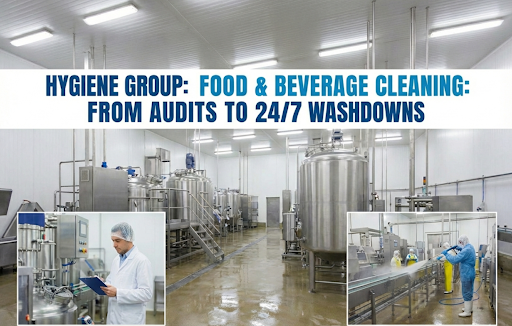
When selecting a provider for commercial & industrial cleaning UK, technical managers must move beyond generic janitorial services. Passing rigorous BRCGS or SALSA audits requires a bespoke, methodical approach to contamination control. Hygiene Group delivers systematic, accredited cleaning protocols tailored exclusively to high-risk food, beverage, and pharmaceutical manufacturing environments.
- Specialist Compliance: Generalist cleaners miss critical harbourage points; specialists ensure constant audit readiness and operational compliance.
- Risk Mitigation: Applying a structured decontamination process effectively eliminates microbial risks and hazardous allergen cross-contamination.
- Operational Uptime: Methodical sanitisation protocols minimise scheduled production downtime and definitively protect product integrity.
The Fundamental Difference: Generalist Cleaners vs Specialist Hygiene Partners
Generalist cleaners lack the technical training required for high-risk manufacturing environments and focus primarily on visual cleanliness. A specialist partner applies validated scientific methods to systematically eliminate microscopic pathogens, ensuring absolute compliance with stringent food and pharmaceutical production standards.
Plant and Technical Managers understand the intense pressure associated with unannounced compliance audits. The requirement for meticulous hygiene cannot be satisfied by standard commercial cleaning services UK providers, who often deploy transient staff without specialised training. High-risk manufacturing demands a clinical, results-driven methodology where every action is logged, validated, and verifiable. Relying on an industrial cleaning company that does not understand the complexities of microbial degradation or allergen control introduces unacceptable commercial risks.
"Compliance is not a periodic event; it is a constant state of readiness," states Gurdip Bir, Managing Director. "By deploying a fully accredited, systematic approach, we remove the operational anxiety associated with unannounced audits and allow technical managers to focus entirely on maintaining production uptime."
The Hidden Costs of Ineffective Sanitisation
The financial and reputational consequences of poor hygiene are severe. According to the Food Standards Agency, around 2.4 million cases of foodborne illness occur every year in the UK, underscoring the immense societal and corporate risk of inadequate pathogen control. Visual cleanliness is entirely insufficient when dealing with invisible threats like Listeria monocytogenes or Salmonella.
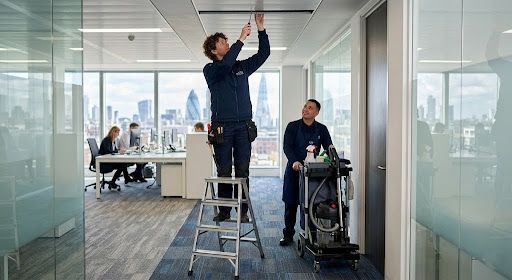
When generalist providers fail to reach high-level infrastructure or properly sanitise complex machinery, they leave behind biofilms that contaminate entire production runs. This leads directly to failed audits, expensive product recalls, and severe brand damage. Technical Managers must prioritise contract commercial cleaning partners who utilise scientific verification methods rather than merely relying on physical appearances.
Authority and Expertise in Action
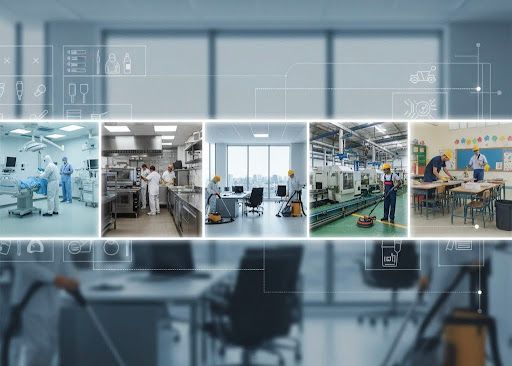
Choosing a provider dedicated solely to food and pharma ensures that your facility is managed by true industry experts. Unlike facilities management companies that clean retail parks and office blocks, a specialist partner focuses exclusively on high-care environments. This targeted expertise means that whether your facility requires daily disinfection or periodic deep cleaning, the protocols applied meet the exacting demands of modern manufacturing.
Working with an expert across diverse industry cleaning sectors ensures that hygienic standards are maintained uniformly. A methodical provider understands that an effective sanitisation programme is the foundation of total due diligence, safeguarding both the end consumer and the manufacturer's operational licence.
Why is a Systematic Technical Process Critical for Audit Compliance?
A systematic cleaning process provides the exact documented verification required by rigorous auditors. Utilising structured methodologies ensures that all contamination risks, from allergen cross-contact to stubborn biofilm formation, are systematically eliminated and documented for absolute due diligence.
Modern BRCGS Issue 9 audits demand comprehensive proof that cleaning programmes are not only executed but are scientifically effective. Auditors require extensive documentation showing that chemical contact times, water temperatures, and mechanical action have been applied correctly. A bespoke, systematic approach removes human error from this equation, standardising the process to guarantee consistent, compliant results every single shift.
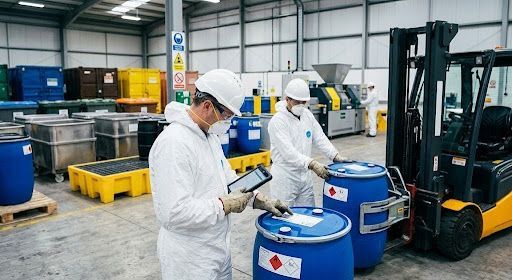
Furthermore, adherence to ISO 14001 environmental standards requires precise chemical management. Industrial cleaning chemicals must be specifically formulated for the soil type present in the facility and applied at the correct concentrations to ensure efficacy while minimising environmental impact. A specialist partner manages this complex chemical matrix flawlessly.
The Scientific Approach to Pathogen Control
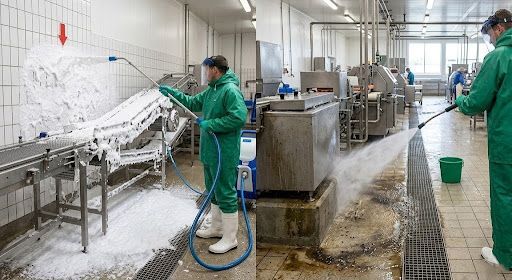
In high-risk environments, cleaning services for businesses must transition from basic janitorial work to advanced pathogen control. This requires a deep understanding of microbiology and chemical interactions. For example, applying highly alkaline foaming agents provides the extended surface contact time necessary to break down protein and fat-based soils on vertical stainless steel surfaces.
If organic matter is not completely removed before the final disinfection stage, the residual proteins will rapidly neutralise the sanitiser. This creates a false sense of security where surfaces appear clean but remain microbially active. A systematic process guarantees that the physical removal of organic load always precedes chemical disinfection, ensuring maximum pathogen elimination.
The Four-Stage Decontamination Protocol
To achieve continuous audit readiness, specialists employ a rigorous, non-negotiable methodology. This structured approach is the defining characteristic of elite contract cleaning services:
- Preparation and Dismantling: Ensuring all production machinery is safely locked off, securely isolated, and sensitive electrical components are protected prior to the sanitisation programme commencing.
- Gross Soil Removal: Methodical physical extraction of all visible organic matter and debris. Thorough completion of this stage is vital to prevent the subsequent neutralisation of chemical disinfectants.
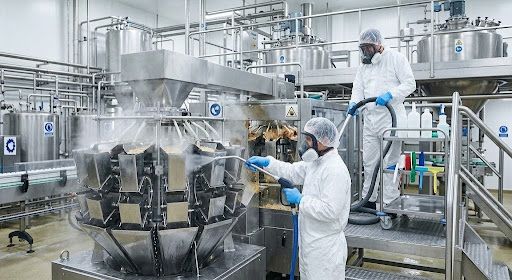
- Bespoke Chemical Application: Utilising specialised foaming agents and detergents formulated for specific soil types, ensuring optimal chemical contact time to penetrate and dissolve stubborn biofilms.
- Verification and Documentation: Executing post-rinse ATP (Adenosine Triphosphate) swabbing and stringent visual inspections to guarantee microbial reduction, providing the exact due diligence records required for immediate compliance verification.
How Do Sector-Specific Challenges Impact Your Hygiene Strategy?
Different manufacturing environments present highly specific microbial and physical safety hazards. From explosive airborne dust risks in bakeries to complex drainage biofilms in breweries, a bespoke hygiene strategy must neutralise the precise biological threats of your facility.
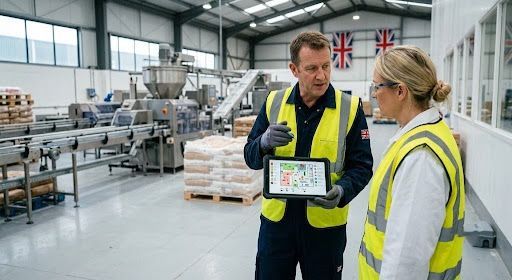
Generic cleaning schedules cannot accommodate the vast differences between food, beverage, and pharmaceutical manufacturing. Each sector operates under unique regulatory frameworks and faces distinct contamination pressures. A technical hygiene partner must conduct a comprehensive site survey to identify specific risk profiles and design a sanitisation programme that precisely targets the vulnerabilities of your production line.
Mitigating Explosive and Respiratory Risks in Bakeries
In industrial bakeries, airborne flour dust is not merely an allergen; it represents a critical occupational health hazard and a severe explosive risk under DSEAR and ATEX regulations. The Health and Safety Executive states that occupational asthma comprises 33% of food industry compensation cases, with flour and grain dust identified as primary causal agents.
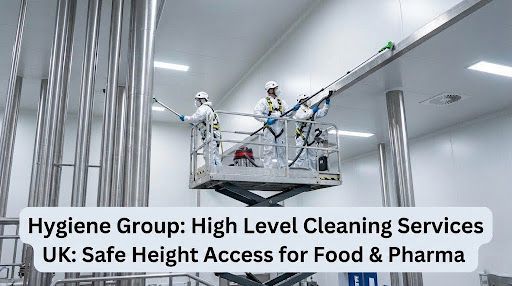
Standard vacuuming or sweeping simply agitates these hazardous particles, redistributing them across the facility. Specialist hygiene teams utilise ATEX-rated extraction equipment and methodical high-level cleaning techniques to safely capture combustible dust. This targeted approach protects worker respiratory health, ensures compliance with COSHH regulations, and completely neutralises the threat of catastrophic dust explosions.
Combating Biofilms in Breweries and Pharmaceutical Plants
Conversely, wet manufacturing environments such as breweries, dairies, and pharmaceutical plants present severe microbial challenges. Drains, gullies, and complex pipework provide the perfect damp, nutrient-rich conditions for Listeria and other persistent biofilms to thrive. Generalist cleaners frequently overlook these hidden harbourage points, leading to continuous re-contamination of the production environment.
Furthermore, wet floors pose a significant physical hazard to the workforce. Data from the Health and Safety Executive reveal that slips and trips account for 35% of major injuries in the food and drink industries, with the vast majority resulting from inadequate floor degreasing. Implementing an expert hygiene contract cleaning UK protocol ensures floors are systematically degreased and sanitised, radically improving site safety and compliance.
What Makes a Specialist Cleaning Partner Reliable?
Reliability stems directly from rigorous training and workforce stability. An accredited provider utilises highly trained, permanently employed operatives who understand complex safety protocols, guaranteeing consistent standards, continuous operational uptime, and total confidence during unannounced compliance audits.
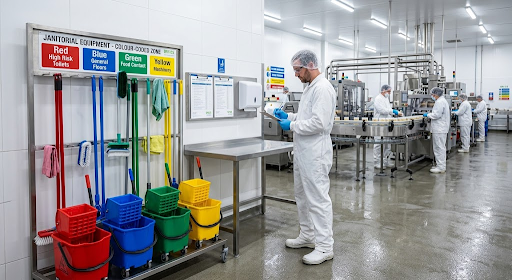
Technical Managers require a partner they can trust implicitly. With over 35 years of dedicated experience solely within the food and pharma sectors, a true specialist does not rely on transient agency workers. Operating within highly regulated environments demands a workforce that is deeply familiar with site-specific rules, allergen zoning, and strict colour-coding protocols. This level of institutional knowledge prevents cross-contamination and ensures seamless integration with your internal quality department.
Workforce Stability and Technical Competence
High staff turnover is the enemy of consistent hygiene. When new operatives are constantly cycled through a facility, the risk of critical errors multiplies. This is why learning about Hygiene Group provides immediate peace of mind. Holding the prestigious "Investors in People" silver status demonstrates a fundamental commitment to staff retention, continuous technical training, and professional development.
A respected, well-compensated workforce executes its duties with precision and pride. They do not cut corners. They understand the severe implications of microbial contamination and operate as highly trained technicians rather than basic cleaners. This stability translates directly into flawless audit results and total operational reliability for the client.
Securing Operational Uptime
Ultimately, choosing the correct industrial cleaning company is about securing your operational uptime. Deep cleaning and sanitisation must occur seamlessly during scheduled downtime. Delays in the cleaning process mean production lines start late, costing thousands of pounds in lost manufacturing capacity. A systematic partner executes complex turnarounds efficiently, ensuring that machinery is meticulously sanitised, verified, and ready for production the moment the shift begins.
Risk mitigation is the core responsibility of any Plant or Technical Manager. Partnering with Hygiene Group provides the definitive, accredited assurance required to protect your facility, your staff, and your brand from the devastating consequences of non-compliance.
Ensure your facility is audit-ready. Call our specialist team on
0121 451 3211, email
enquiries@hygiene.co.uk, or
request a site survey here.