The Process of Warehouse Cleaning

March 19, 2022

Warehouses are typically large and spacious, making them the perfect place for storing products and materials. However, just like any other area of a business, warehouses require cleaning and maintenance to keep them functioning properly.


The warehouse routine and deep cleaning process is one that is often overlooked, but it is a critical part of maintaining a clean and organised workplace. Deep cleaning in a warehouse may seem like an unnecessary hassle, but it is actually very important for the safety and well-being of your employees. 


By following a routine deep-cleaning schedule, you can keep your warehouse running safely and efficiently. Here are the components of a warehouse deep cleaning process:


  • Floor de-greasing, cleaning, and drying


Design a cleaning plan that addresses higher traffic areas like docking areas where packing materials tend to accumulate. Once you have identified the most cluttered zones, assign priority cleaning tasks for daily, weekly, or monthly cleaning

Now that you have determined the cleaning frequencies for all the areas, it is time to start cleaning the floors. This starts by removing all gross debris from the space like cardboard boxes, bubble wrap, papers, and so on. The next step involves sweeping and then mechanically scrubbing the floor with a detergent or disinfectant. The floor must then be dried completely to avoid any potential slips or falls. In most cases, it's best to hire a professional crew to do the job right.


  • Mezzanine and racking cleaning


As you continue your warehouse deep cleaning, The next step is to create a cleaning matrix for maintaining the racking and mezzanine areas. Cleaning these areas can be a challenging task, but with the right tools and knowledge, it can be done quickly and easily. This involves removing any debris or dust from the shelves, as well as thoroughly cleaning the racks on a periodic basis.


  • Air filtration and ventilation cleaning


Cleaning air filtration and ventilation systems remove contaminants from the air ensuring the air quality is clean. Not only will this improve the air quality for workers, but it will also help protect products from contamination


  • Machine cleaning and de-greasing


When it comes to warehouse deep cleaning, many people think of the usual sweeping, mopping, and dusting. However, there is a lot more to deep cleaning a warehouse than that. In some cases, machine cleaning and de-greasing are necessary steps in order to get the space truly clean.


This process will remove all visible built-up dirt and grease from the machines in the warehouse, restoring them to their original condition.
By using a qualified contractor, you can be sure the job will be done properly and quickly.


  • Staff washrooms and WCs


  • Now that the warehouse is clean, it is time to move on to the staff washrooms. These areas tend to be a little dirtier than the rest of the warehouse, so they need a bit more attention. This is an important task, as clean and sanitary restrooms are a necessity for all employees. The process of cleaning the washroom includes these steps:
  • Cleaning all surfaces with a disinfectant cleaner. 
  • Wiping down all fixtures, including taps, mirrors, soap dispensers, hand driers walls and light fixtures.
  • Disinfecting the toilet and sink areas.
  • Washing floor areas with a detergent sanitiser.


  • Cleaning cafeterias, staff rooms, and kitchens


To achieve total cleanliness, all areas of your warehouse need to be considered, including the cafeteria, staff room, and kitchen. These areas need to be cleaned at a minimum once per shift. In fact, they may even require more attention due to the amount of traffic they see daily.


  • High-level and lighting cleaning


The goal of this process is to clean all the dirt, dust, and debris from the walls, ceilings and all of the light fixtures and remove any build-up that may have occurred over time. This will help to improve the brightness and clarity of the light emitted from the fixtures.


  • External fascia cleaning


This involves removing all the dirt and debris from the outside of the building. This can be done by using a pressure washer or reach and wash cleaning systems to clean the facade of the building.


  • Car park cleaning


When it comes to keeping a warehouse clean, outside areas such as car parks, loading docks ,entrances and vehicle workshops are just as important. These areas must be kept clean and free of debris. This can be done by using pressure washers and other equipment to clean every nook and cranny. Maintaining the outside areas will help prevent unwanted pests like rodents entering the warehouse and damaging product.


Hygiene Group
is a UK-based company that provides warehouse deep cleaning services for warehouses of all shapes and sizes. We have been providing our services for over 35 years and are working with the relevant organisations to provide high-quality service. If you're looking for a good, reliable company who can help your business keep its premises clean and tidy, contact us today!
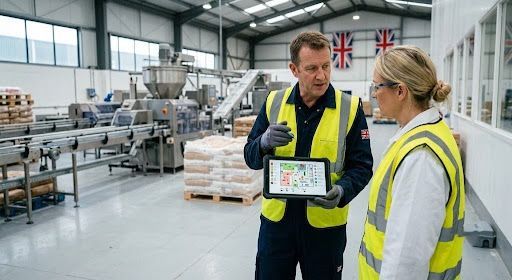
Two factory workers in high-vis vests review a tablet in a manufacturing facility.
July 23, 2026
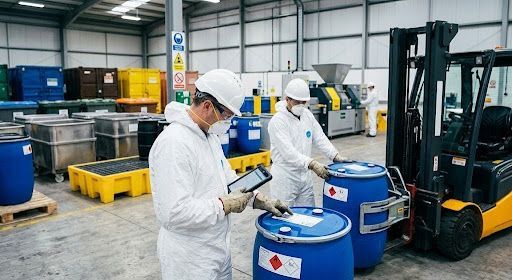
Need expert pest control services UK for your factory? We provide audit-ready prevention plans for food and pharma. Call 0121 451 3211 for specialist help.
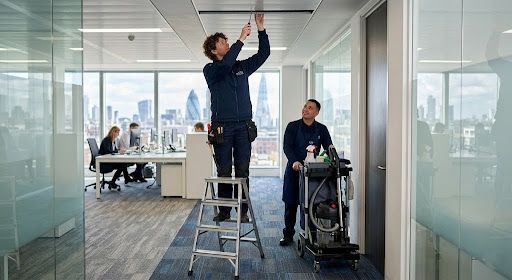
Two workers in a glass-walled office, one on a ladder adjusting ceiling lights, another beside equipment cart.
By Ross Keevins June 25, 2026
Need specialist FM? Discover how our facility management services in the UK ensure audit compliance. Call 0121 451 3211 for expert food and pharma hygiene.
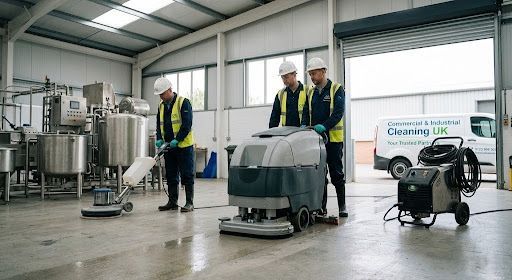
Workers cleaning industrial equipment in a warehouse with polishing machines and stainless steel tanks.
May 15, 2026
Need specialist commercial & industrial cleaning UK? We help food & pharma sites pass audits with a 4-step approach. Site survey, call 0121 451 3211.
Workers in green uniforms clean a fish-processing room with hoses and stainless steel equipment.
April 24, 2026
Master audit compliance with expert guidance on foam vs rinse-only protocols. Mitigate microbial risk today. Call 0121 451 3211 for specialist support.
Two workers in white protective suits and masks deep-clean industrial food processing machinery with hoses.
March 27, 2026
Secure BRCGS compliance with specialist equipment cleaning services UK. Mitigate microbial risk and ensure audit success. Call our team on 0121 451 3211.
Workers in protective suits on a lift cleaning high-level equipment in a food or pharmaceutical facility.
February 19, 2026
Specialist high-level cleaning services UK for food & pharma. IPAF-qualified teams ensure BRCGS & ISO compliance. Call 0121 451 3211 for a site survey.
Person in blue medical suit putting on gloves in a medical setting, near a waste bin and supplies.
January 30, 2026
In the pharmaceutical sector, hygiene is not merely a housekeeping task; it is a critical control point in the manufacturing process. For Technical and Quality Ma...
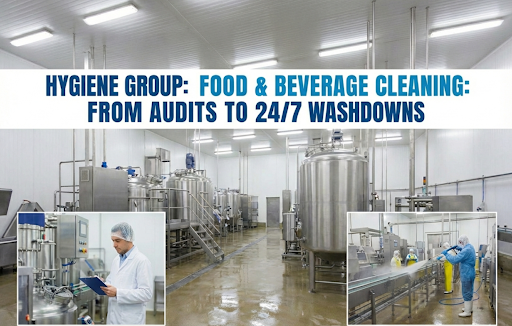
Food and beverage plant with workers, machinery, and title: Hygiene Group, Food & Beverage Cleaning.
December 12, 2025
Secure your next audit with Hygiene Group. Expert food & beverage cleaning services ensuring compliance & safety. Call 0121 451 3211 for a specialist partner.
Five different work environments: operating room, kitchen, office, factory, classroom.
November 28, 2025
Build a compliant, industry-specific hygiene plan. This expert guide details systematic cleaning solutions for food, pharma, and other regulated sectors.
Man mopping an office floor, with cleaning supplies and wet floor sign.
September 22, 2025
Cleanliness isn’t just a food-factory issue. Hygiene standards in offices, retail stores, and distribution centres impact safety, brand perception, compliance, and productivity. Dust on a warehouse truss can raise fire risk. A grimy trolley handle can undo an otherwise brilliant customer experience. A poorly specified floor regime can turn a busy corridor into a slip hazard. Hygiene matters everywhere. Two things are essential to make hygiene practical across mixed estates: a provider that adapts methods to each environment, and access to the right products and equipment for day-to-day upkeep. Hygiene Group delivers both. Our cleaning services for other industries outside of food production and pharma, cover workplace, logistics, commercial premises, and retail environments with sector-specific routines and trained teams. We also supply quality janitorial supplies in the UK —including materials and equipment—so site teams can keep standards high between scheduled cleans. The challenge: different environments, different risks Offices and shared workplaces. Hygiene in offices is about visible standards and touch-point control. Reception desks, lift buttons, handrails, keyboards, meeting tables, and washrooms see continuous use. The regime here focuses on frequent touch-point disinfection, smart scheduling to avoid disruption, and consistent presentation (windows, floors, bins, odour control). Where hybrid work patterns change occupancy, frequencies should flex accordingly. Hygiene Group’s workspace offer emphasises wellbeing, productivity, and tailored schedules—useful when attendance varies week to week. Retail and customer-facing spaces. In stores, changing footfall demands agile cleaning. Front-of-house appearance, safe aisles, and spotless welfare areas underpin brand reputation. Early morning “reset” cleans, day-janitor spot checks, and rapid spill response keep standards steady without interrupting trade. Store cleans extend to back-of-house loading areas and waste zones, which can attract pests if neglected—coordination with waste routines is critical. Hygiene Group highlights store cleaning delivered around trading hours and site realities. Warehousing, distribution & logistics. Large volumes, heavy MHE traffic, and high-level structures create a unique risk profile. Think tyre dust, diesel particulates, pallet debris, and overhead dust that can shed onto pick lines. The cleaning playbook here includes machine-scrubbed floors, periodic high-level hygiene cleaning, dock-door and racking detail, plus amenity blocks sized for shift patterns. Hygiene Group’s logistics planning reflects these constraints and the need to work around live operations. Commercial premises and mixed estates. Multi-tenant offices, labs, or light manufacturing sites require a single playbook that still flexes per floor or tenant. Consistency and minimal disruption are key, from deep cleans pre-occupation to overheads and equipment cleans ahead of audits. Getting the specification right: methods that match the setting Floor care that suits the traffic: In offices, low-noise vacuums and periodic low-moisture carpet care protect finishes. Autoscrubbers, degreasers, and defined walkway cleans keep slip risk low and warehouse traffic routes clear. High-level hygiene cleaning (where relevant): Distribution centres and some commercial spaces accumulate dust on trusses and cable trays. Planned high-level works prevent fallout, reduce fire load, and protect HVAC performance. Touch-point routines with proof: For offices and retail, agreed checklists and cadence (opening checks, hourly sweeps, closing resets) keep hygiene visible and auditable. Welfare and back-of-house discipline: Clean break areas and changing rooms reduce the transfer of soils to public or production spaces. Waste and pest awareness: Good housekeeping prevents overflow and harborage, and it is especially important behind stores and at loading bays. The product piece: good outcomes need the right kit Great operatives still need reliable, fit-for-purpose products. The wrong mop, pad, or chemical can waste time and damage finishes. Hygiene Group can supply commercial janitorial products and cleaning supplies for industry through its dedicated channel—with over 2,000 product lines covering products, materials, and equipment (specialising in supply to food manufacturing where compliance and reliability are paramount). This depth means facilities can standardise consumables, avoid mismatched items, and keep spares on hand. When choosing industrial janitorial supplies for non-food environments, consider: Surface compatibility: Match chemistry to finishes—stone, LVT, epoxy, stainless steel, glass, powder-coat. Productivity aids: Microfibre systems with colour-coding, backpack vacuums for stairs, extended poles for glazing, and autoscrubbers for large floors. Air quality and noise: HEPA filtration and quiet operation support well-being in offices and retail. Sustainability signals: Concentrates, dosing systems, and recyclable packaging reduce waste and cost. Compliance support: Clear safety data, COSHH guidance, and training materials for safe, repeatable use. Where estates straddle multiple sectors, consolidating to a consistent catalogue (pads, bags, chemicals, gloves, dispensers) makes training easier and reduces procurement friction—this is where contract cleaning supplies in the UK add real value. Sample hygiene frameworks by environment Office/workplace: Daily: bins, touch-points, washrooms, kitchens, reception floors, visible dusting. Weekly: glass and partitions, fabric spot cleaning, hard-floor maintenance. Periodic: carpet extraction, deep washroom descales, high-dusting in low-risk zones. Supplies: hand soap and sanitiser, paper, microfibre, multipurpose cleaner, neutral floor cleaner, screen wipes. Retail/store: Daily: entrance mats, spills and slip prevention, trolleys/baskets, till areas, customer washrooms. Weekly: back-of-house deep tidy, back-room floors, stockroom racking wipe-downs. Periodic: signage/glazing, back-of-house waste bays, canopy or signage cleans (as needed). Supplies: rapid-dry floor cleaner, glass cleaner, odour control, and food-safe sanitiser for food-adjacent areas. Warehouse/distribution: Daily: machine-scrubbed traffic routes, pedestrian walkways, dock levellers, canteens, and locker rooms. Weekly: pick-face dusting, low-level racking, MHE charge areas. Periodic: industrial high-level cleaning of rafters/cable trays; external yard sweeps. Supplies: degreasers suited to concrete/epoxy, scrubber pads, litter pickers, industrial wipes, and spill kits. Commercial premises/mixed sites: Daily: common areas and lifts, meeting rooms, washrooms, café spaces. Weekly: feature surfaces, blinds, vents. Periodic: strip-and-seal where suitable; targeted deep cleans ahead of moves or audits. Supplies: neutral hard-floor cleaner, disinfectant for touch-points, stainless steel polish where appropriate. Why a single partner helps Bringing cleaning services from other industries under one provider reduces admin and lifts consistency—especially across multi-site portfolios. Hygiene Group’s industry coverage includes workspace cleaning, distribution & logistics, commercial premises and store cleaning, supported by recognised accreditations (ISO 9001, ISO 14001, SafeContractor, Investors in People). One SLA, one set of KPIs, one safety system; less time reconciling competing schedules, more time focusing on the job. Because the same organisation also provides your UK janitorial supplies, sites can standardise on proven products, streamlining purchasing and ensuring front-line teams always have what they need to maintain standards between visits. With a deep catalogue of materials and equipment, specifying contract cleaning supplies in the UK becomes simpler and more reliable.  Getting started: a simple plan for non-food industries Survey each environment: Note occupancy, touch-points, floor types, access constraints, and height work. Define risk-based frequencies: Match cleaning to use patterns and public exposure. Create a core product set: Lock in a unified list of cloths, mops, pads, chemicals, dispensers, and liners by site type. Integrate waste and pest checks: Clear responsibilities in back-of-house areas are needed to avoid hygiene blind spots. Audit, report, improve: Use short dashboards to track KPIs such as presentation scores, slip incidents, complaints, and rectification times. Hygiene Group brings 35+ years of practical experience from regulated sectors to these industries, applying proven routines and products to deliver standards your teams, and your customers, can see daily. For a broader view of capability across sectors and services, start with our industrial hygiene services, UK overview.